Whether you are in Simi Valley or Porter Ranch, like the client in our recent irrigation project, a burst sprinkler supply line can quickly become a household problem. Two important parts of a serviceable irrigation supply are a reliable isolation shutoff and properly selected pressure control. One gives you a way to stop the water during a leak or repair. The other helps keep excessive supply pressure from reaching downstream irrigation components.
If you are dealing with recurring PVC pipe leaks, broken sprinklers, or noisy irrigation valves, replacing the latest failed part may leave the underlying issue unresolved. An irrigation supply assessment should look at the pressure, piping condition, valve operation, and where the system connects to the home’s water service.
Why a reliable irrigation shutoff valve matters
An irrigation shutoff isolates the outdoor irrigation supply from the water feeding the rest of the property, when the piping is arranged for independent isolation. During a burst pipe or valve failure, that can let the homeowner stop irrigation water while keeping the house supplied. Without a working isolation valve, the house main may be the only effective way to stop a major outdoor leak.
That distinction matters during repairs. Losing irrigation for a few hours is inconvenient; losing water to toilets, sinks, showers, and the kitchen creates a much larger disruption. A dependable shutoff also makes future valve replacement and irrigation supply maintenance easier to plan.
Turning off the sprinkler controller may not stop a supply leak
The controller tells individual irrigation control valves when to open and close. It does not necessarily remove pressure from the supply piping feeding those valves. A broken supply line upstream of the valve bank can continue leaking after the timer is switched off. A mechanically stuck control valve may also fail to close. The isolation shutoff serves a different purpose: stopping water entering the irrigation branch.
A valve must be accessible and able to close
A shutoff provides little emergency protection if nobody can find it, reach it, or operate it. Soil, corrosion, deteriorated handles, and years without service can make older installations difficult to use. A buried valve is not automatically defective, but it needs suitable access and protection. On an appropriate installation, an accessible above-ground ball valve provides a clearly identifiable shutoff with a quarter-turn operating action.
Knowing the location is only part of the picture. The valve should also be checked for leakage and its ability to isolate the supply. If an old valve is seized or leaking, have it assessed rather than forcing the handle and risking a break.
What does an irrigation pressure reducing valve do?
A pressure reducing valve, commonly called a PRV, lowers higher incoming water pressure to a suitable downstream setting within the valve’s operating limits. A properly sized PRV responds as demand changes, helping manage the pressure delivered to the irrigation supply. It cannot increase low incoming pressure, and its performance depends on correct sizing, installation, condition, and available supply.
The shutoff and PRV perform separate jobs. The shutoff provides manual isolation for emergencies and service. The PRV manages pressure during normal operation. A PRV should not be relied on as an emergency shutoff or an automatic leak detection device.
How excessive pressure affects sprinklers and irrigation piping
Sprinklers and irrigation components are designed for particular operating conditions. Excessive pressure can contribute to fine misting, poor spray patterns, and wasted water. It can also increase stress on piping, joints, seals, and valves. Correct pressure helps equipment operate closer to its intended performance.
However, a burst PVC line or broken sprinkler is not proof of high pressure by itself. Aging pipe, damaged fittings, poor joints, impact damage, and installation problems can also cause failures. Repeated repairs are a reason to investigate the supply and system condition together, rather than assuming a PRV will solve every leak.
Why the house pressure regulator may not protect the irrigation supply
Some irrigation branches connect to the water service before the house PRV. In that arrangement, the home may have regulated pressure while the irrigation still receives the higher upstream pressure. Other properties have irrigation connected after the house regulator. The actual piping layout determines what is protected.
A dedicated irrigation PRV can be appropriate when that branch needs its own pressure control. It must be selected for the irrigation demand and installed in the correct location. Pressure-regulated sprinkler heads or zone regulators can also serve specific purposes, but a regulator at a head does not regulate the upstream supply piping.
For help evaluating your supply, learn about our water pressure and PRV services and water service and main water line repairs.
Pressure testing matters more than choosing a generic PSI setting
There is no single pressure setting that suits every irrigation system. Sprays, rotors, and drip equipment may have different requirements. Pipe size, elevation, the number of devices operating, and pressure losses through fittings and backflow equipment also affect the pressure available at the sprinklers.
A useful assessment considers both static pressure, measured when water is not flowing, and operating pressure, measured while the system is running. A reading that appears acceptable with everything off may not reveal a restriction or excessive pressure loss under demand. The selected PRV must also suit the expected flow range.
Noisy valves or banging pipes deserve attention, but sound alone does not identify the cause. Pressure problems, rapid valve closure, debris, worn parts, and loose piping may require different repairs. Pressure regulation can address excessive supply pressure; it is not a guaranteed cure for every water hammer or valve noise issue.
Porter Ranch example: a seized shutoff forced a whole-house shutdown
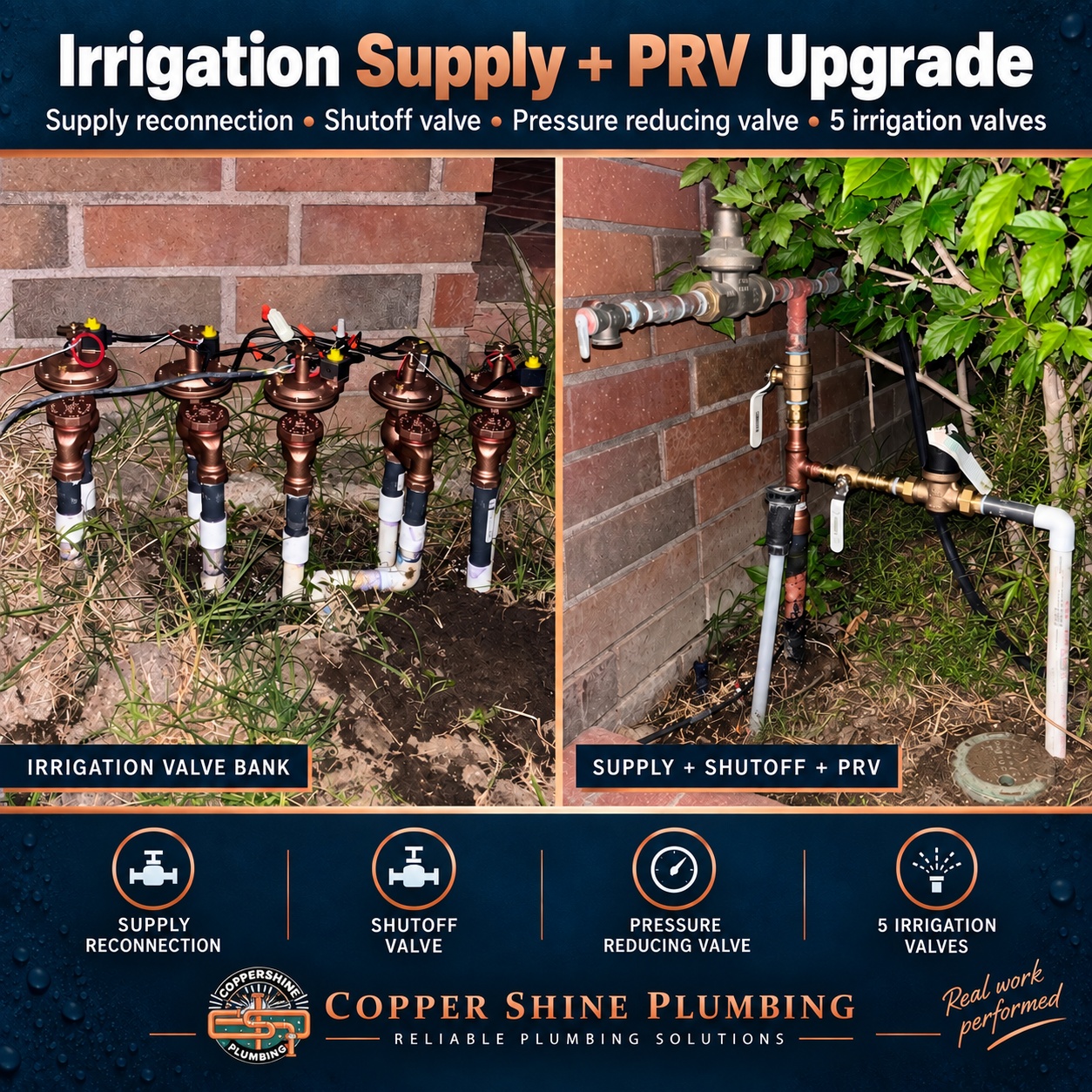
Our Porter Ranch client had experienced bursting PVC lines, broken sprinklers, and noisy irrigation valves. When a major irrigation burst leak occurred, the underground shutoff was seized. The homeowner had to shut off water to the whole house to stop the irrigation leak.
We rerouted the irrigation supply, capped the old in-ground shutoff, installed an accessible above-ground ball valve and a dedicated PRV, and replaced five irrigation control valves. The project addressed access and pressure control as well as the valve bank. Read the our recent irrigation project in Porter Ranch for the project details.
How brass irrigation valves, an accessible shutoff, and a PRV support longevity
A well-planned irrigation supply upgrade addresses three different sources of trouble: component condition, emergency access, and excessive pressure. Together, properly selected brass irrigation valves, an accessible above-ground shutoff, and a correctly sized PRV can help support a longer service life and make future repairs more manageable.
Brass irrigation valves: durable bodies with serviceable components
Quality brass irrigation valves can be a practical upgrade when replacing an aging or repeatedly troublesome valve bank. Their metal bodies provide a robust construction, and models with available replacement components can allow future servicing without replacing the complete assembly. The valve still needs to be appropriate for the water quality, pressure, flow, and intended installation.
Brass does not make a valve maintenance-free. Diaphragms, seals, solenoids, and other operating parts can wear or become obstructed by debris. Corrosion resistance also depends on the alloy and water conditions. Material choice should be considered alongside product quality, correct installation, and long-term parts availability.
An above-ground shutoff makes future service easier
When the site and installation requirements allow, bringing the isolation valve above ground makes the handle easier to locate and inspect. It reduces the need to dig through soil or search an overgrown valve box during a leak. The valve and exposed piping still need suitable support and protection from impact, weather, and freezing where applicable.
The benefit is practical: a working, accessible irrigation shutoff can help limit the duration of a leak and lets the irrigation branch be isolated for maintenance without interrupting the house supply when correctly arranged.
A PRV reduces avoidable pressure stress
Even a strong valve body cannot protect every downstream sprinkler head, fitting, or length of PVC from excessive pressure. A properly selected and maintained PRV helps keep supply pressure appropriate for the equipment it serves. Reducing avoidable pressure stress can help support component life, while periodic pressure checks can identify a regulator that needs attention.
No upgrade provides a guaranteed number of extra years or prevents every future leak. Existing pipe condition, sunlight exposure, water quality, installation workmanship, operating cycles, and maintenance all affect irrigation system life. The goal is a durable, serviceable supply with appropriate pressure control, rather than repeatedly replacing damaged parts without evaluating the cause.
What can happen when irrigation supply problems are left unresolved?
If excessive pressure, deteriorated valves, or a seized shutoff remain unaddressed, the property may continue to experience repeat leaks, broken sprinkler components, water waste, and repair costs. A larger burst can saturate landscaping or surrounding soil and may affect nearby structures depending on its location and how long water runs.
A failed isolation valve makes that situation harder to control. As our Porter Ranch project showed, the homeowner may have to shut down water to the entire house. Addressing the valve bank, isolation access, and pressure together can reduce avoidable disruption and provide a more maintainable irrigation supply.
When to request an irrigation supply assessment in Simi Valley
- You cannot locate or operate the irrigation shutoff.
- An outdoor leak requires shutting off water to the entire house.
- PVC piping, fittings, or sprinkler components keep failing.
- Sprinklers produce excessive mist or inconsistent coverage.
- Irrigation valves chatter, bang, leak, or do not close properly.
- You do not know whether the irrigation branch is protected by a PRV.
A shutoff and pressure regulator also do not replace required backflow protection. Each device has its own function, and the supply arrangement should be evaluated as a complete system.
Additional upgrade: Moen Flo whole-home water monitoring
For an added layer of protection, pair your irrigation upgrades with a Moen Flo Smart Water Monitor and Shutoff to monitor water use and pressure, alert you to potential leaks, and automatically shut off the supply when a qualifying issue is detected. It can also monitor and shut off irrigation water when the irrigation branch is downstream of the device, so we assess the piping layout to provide coverage for both the home and irrigation where suitable. Learn about Moen Flo and our automatic water shutoff upgrades for more comprehensive leak protection.
Request irrigation shutoff, PRV, or water main service
Whether your property is in Simi Valley or Porter Ranch, Copper Shine Plumbing can assess irrigation supply piping, shutoff access, and water pressure concerns. We explain the proposed work and provide an upfront price.
Request service for your water main, irrigation supply, or shutoff valve, or call 805-914-9588. Include what is leaking, whether the shutoff works, and photos of the supply or valve bank when available.
1 thought on “Irrigation Shutoff Valves and PRVs: Why Pressure Control Matters in Simi Valley and Porter Ranch”
Comments are closed.